


ACM SIGGRAPH 2026

PatternGSL: A Structured Specification Language for Template-Free and Simulation-Ready 3D Garments

Zhenyang Li* Lutao Jiang* Yizhou Zhao Ying-Cong Chen Xin Wang Weikai Chen Yifan (Evan) Peng

* Equal contribution.

The University of Hong Kong · The Hong Kong University of Science and Technology (Guangzhou) · Carnegie Mellon University · LIGHTSPEED

PatternGSL overview

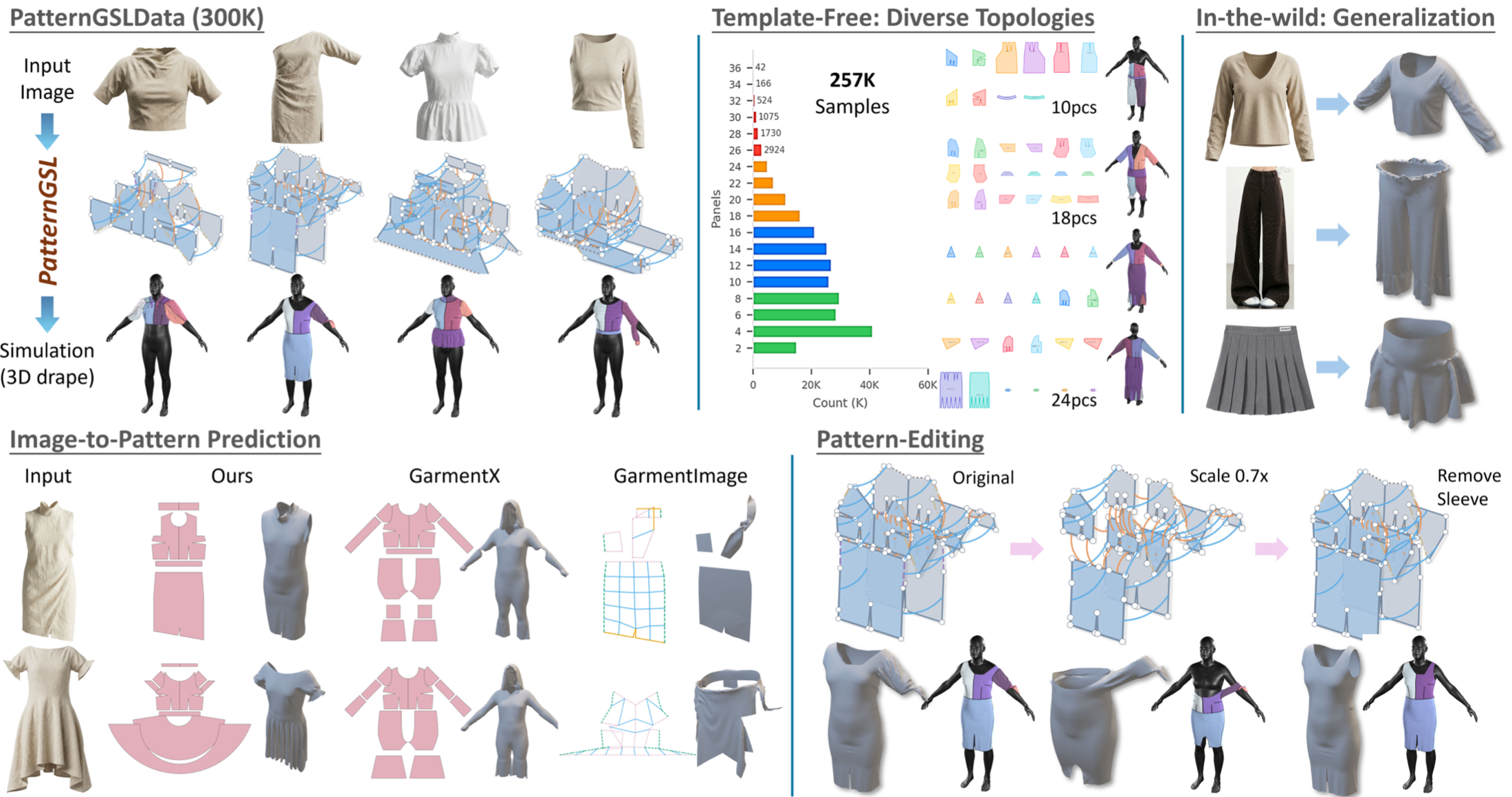
Overview of PatternGSL data, diverse template-free topologies, image-to-pattern prediction, in-the-wild generalization, and pattern editing.
PatternGSL predicts structured sewing patterns from a single image, decodes them into simulation-ready 3D garments, and supports direct pattern-level editing.

Abstract

From a single garment image to editable sewing structure.

Reconstructing realistic, physically plausible garments from a single image remains difficult because template-free geometric methods often lack explicit sewing structure, while programmatic systems are simulation-ready but constrained by predefined templates.

PatternGSL is a template-free, learnable specification language that encodes complete sewing patterns, including panel boundaries, parameterized seams, and explicit stitch topology. A vision-language framework predicts PatternGSL specifications directly from a single image and decodes them into garments through deterministic validity handling, without optimization-based refinement or manual cleanup.

The work introduces PatternGSLData, a large-scale image-to-GSL paired dataset with 300K samples, enabling supervised VLM training for structured garment reconstruction.

Key Features

01

Template-Free Structure

PatternGSL represents arbitrary panel layouts instead of selecting from fixed garment templates.
02

Explicit Stitch Topology

Stitches reference concrete panel-edge pairs, preserving construction connectivity for simulation and editing.

03

Simulation-Ready Decoding

Predicted specifications are decoded with deterministic validity checks before cloth simulation.

04

Pattern-Level Editing

Designers can modify vertices, curves, panels, or placements and reuse the same decoding pipeline.

Method Overview
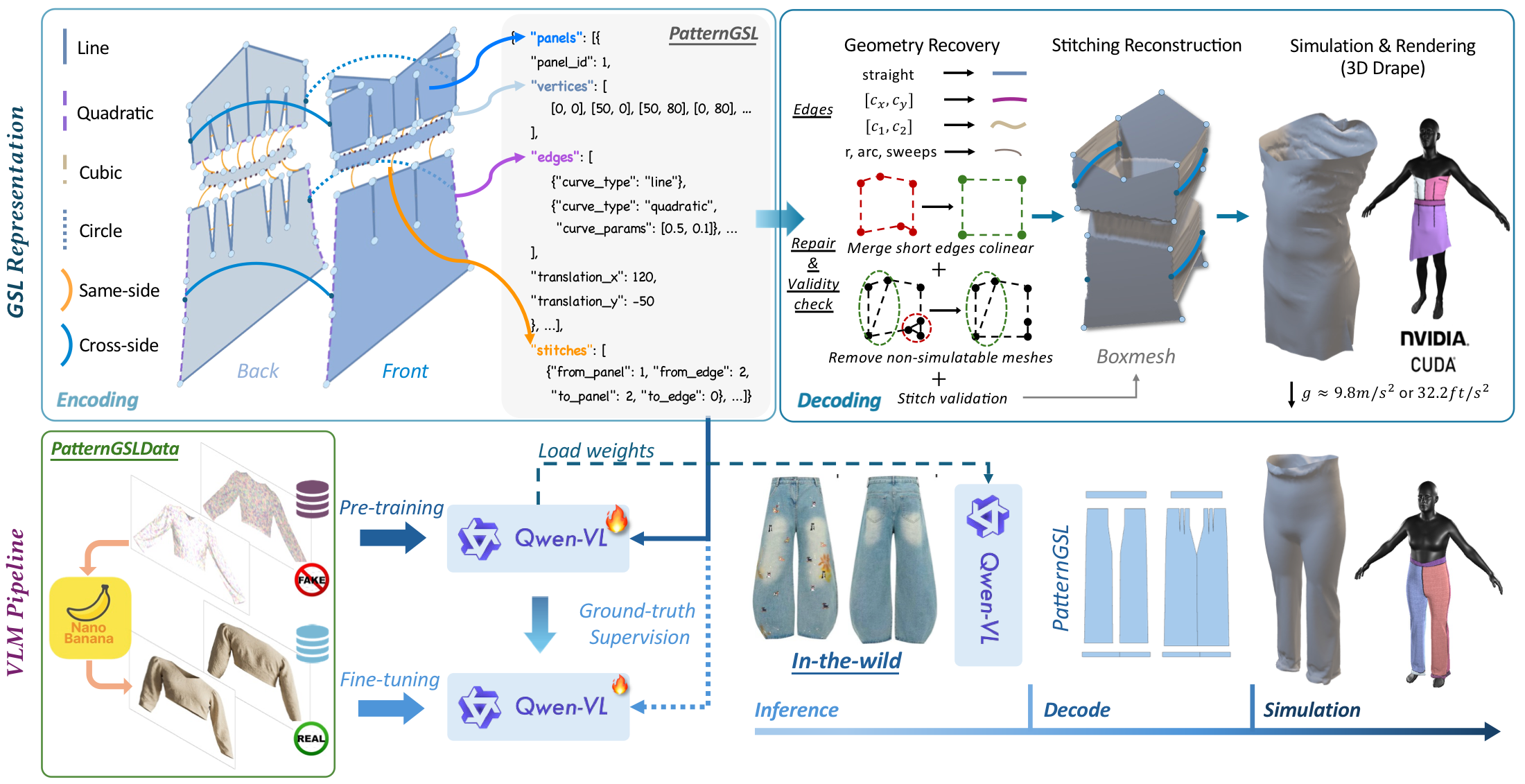
Encode sewing patterns as a compact structured language, then predict it with a VLM.

PatternGSL framework with representation, decoding, VLM training, and inference stages.
The framework encodes panels, curve parameters, placement transforms, and stitch topology as hierarchical JSON, then decodes predictions into physics-ready garments.
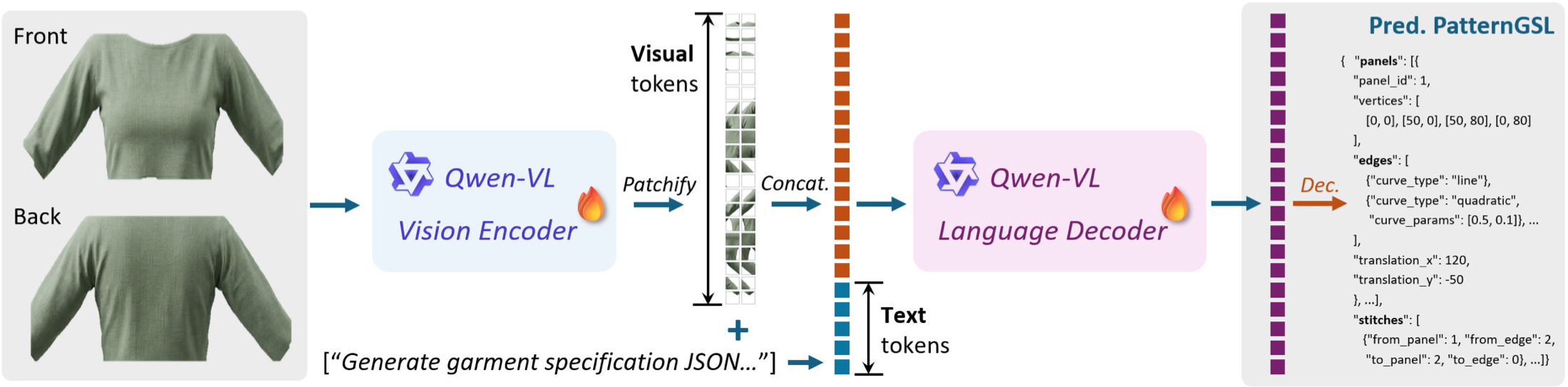
Vision-language model architecture for image-to-pattern prediction with front and synthesized back views.
A Qwen-VL based model observes the front garment image and an auxiliary synthesized back view before generating PatternGSL tokens.

Results

Accurate patterns, reliable draping, and editable output.

5.78 mm 2D Chamfer distance
86.34% 2D IoU
98.48% Stitch accuracy
99.2% Draping success
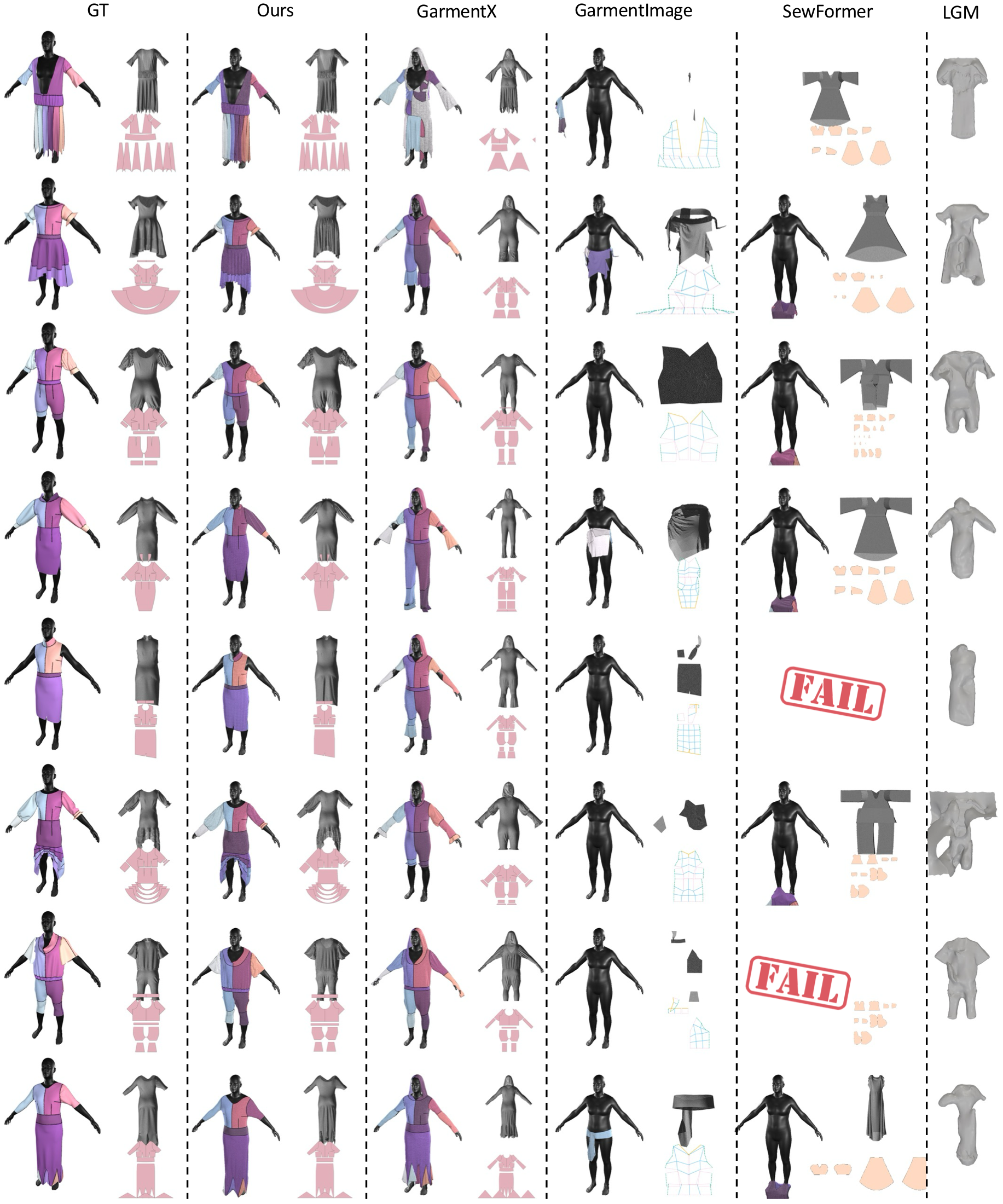
Qualitative comparisons between PatternGSL and baseline garment reconstruction methods.
Qualitative comparisons show PatternGSL recovering sewing patterns and simulated drapes across diverse garment topologies.
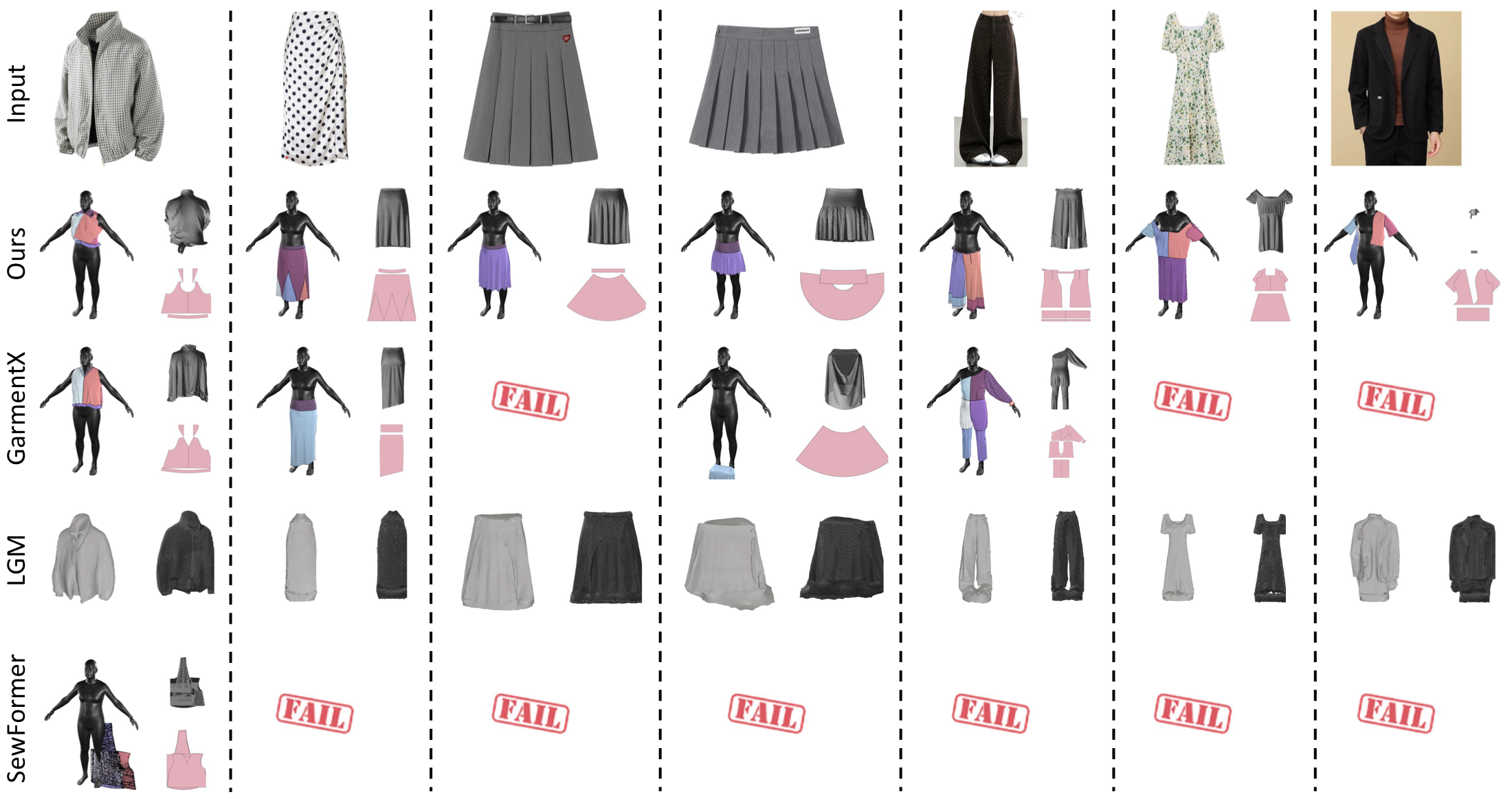
In-the-wild garment reconstruction comparisons.
On in-the-wild images, PatternGSL infers panel geometry and stitch topology where template-based or mesh-only baselines often fail.
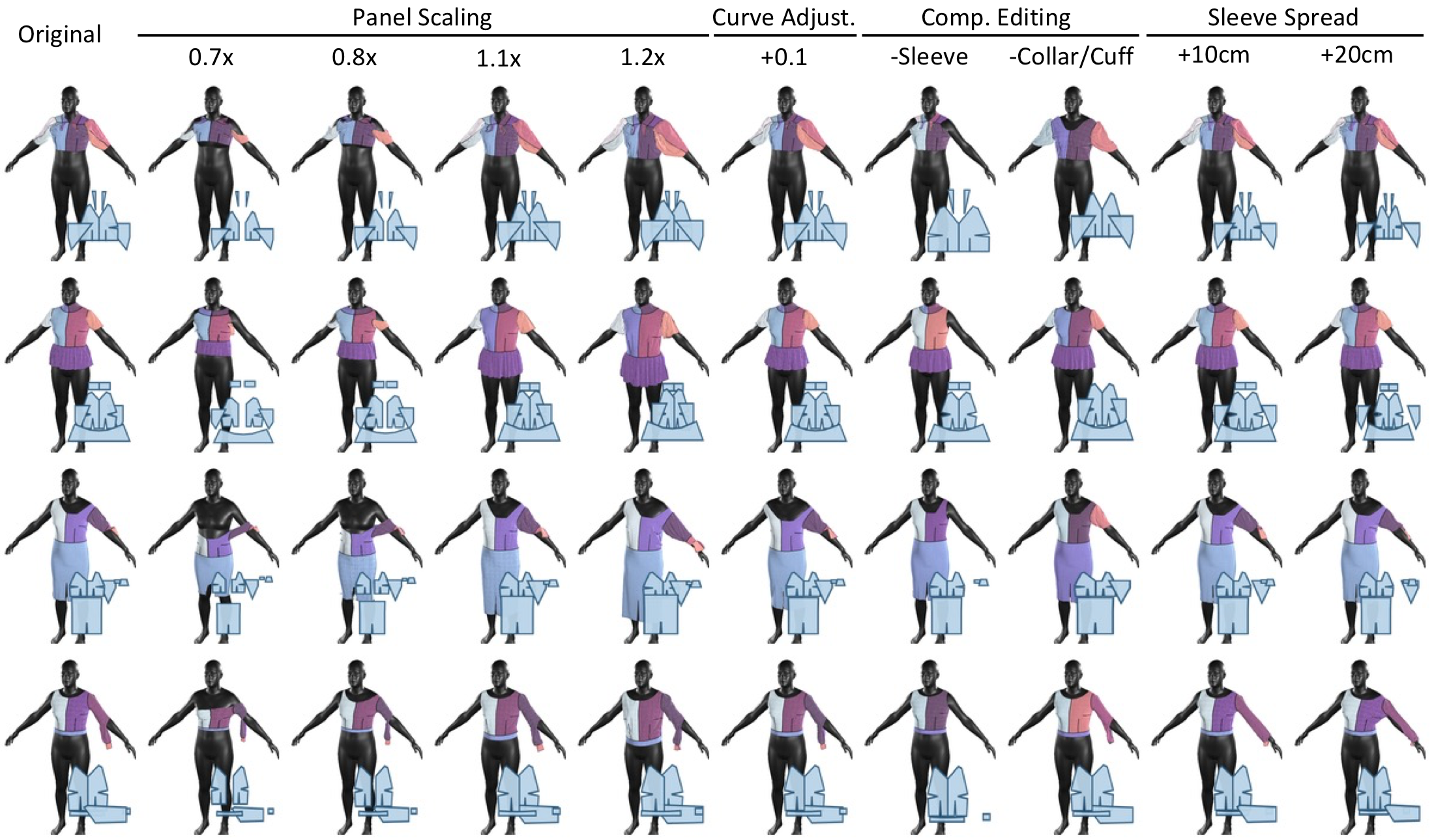
PatternGSL pattern editing examples such as scaling, curve adjustment, component removal, and sleeve spread.
Explicit parameters enable edits such as panel scaling, curve adjustment, component removal, and sleeve spread while keeping outputs simulation-ready.
Pattern-level reconstruction metrics
Method 2D Chamfer ↓ 2D IoU ↑ Stitch Acc. ↑
GarmentImage 47.62 mm 31.20% 18.36%
GarmentX 29.07 mm 58.50% 61.72%
PatternGSL 5.78 mm 86.34% 98.48%

Video

Single-image prediction, simulation, and pattern editing.

BibTeX

Citation

@article{li2026patterngsl,
  title={PatternGSL: A Structured Specification Language for Template-Free and Simulation-Ready 3D Garments},
  author={Li, Zhenyang and Jiang, Lutao and Zhao, Yizhou and Chen, Ying-Cong and Wang, Xin and Chen, Weikai and Peng, Yifan (Evan)},
  journal={ACM Transactions on Graphics (SIGGRAPH 2026)},
  year={2026}
}

Acknowledgements

This page is built for the PatternGSL project and adapted in spirit from the academic project-page style used by StreamSplat and Nerfies-style project pages.